Gibiru search engine
Privacy and Efficiency in Anonymous Searching
Exploring Gibiru
Gibiru is among the few meta-search engines that promise privacy during searches. But is this promise genuine? Are our searches truly secure, or is it merely a marketing gimmick? How do the developers behind Gibiru generate revenue? And is Gibiru user-friendly? We aim to answer all these questions in our comprehensive analysis of the Gibiru search engine.
A Brief Introduction
Gibiru positions itself as a meta-search engine that pledges to deliver private search results. This means your queries are designed not to be "associated with you," thereby circumventing tracking and, even more concerning, profiling.
The meta-search engine has been operational since 2009, although the earliest snapshot recorded by the WayBackMachine is dated January 25, 2011, precisely at 09:31:32.
In 2014, an update to the meta-search engine saw the addition of the Firefox Anonymox plugin, accompanied by the claim: "Use 25 Free International Proxy IP Addresses - Break free from Big Brother."
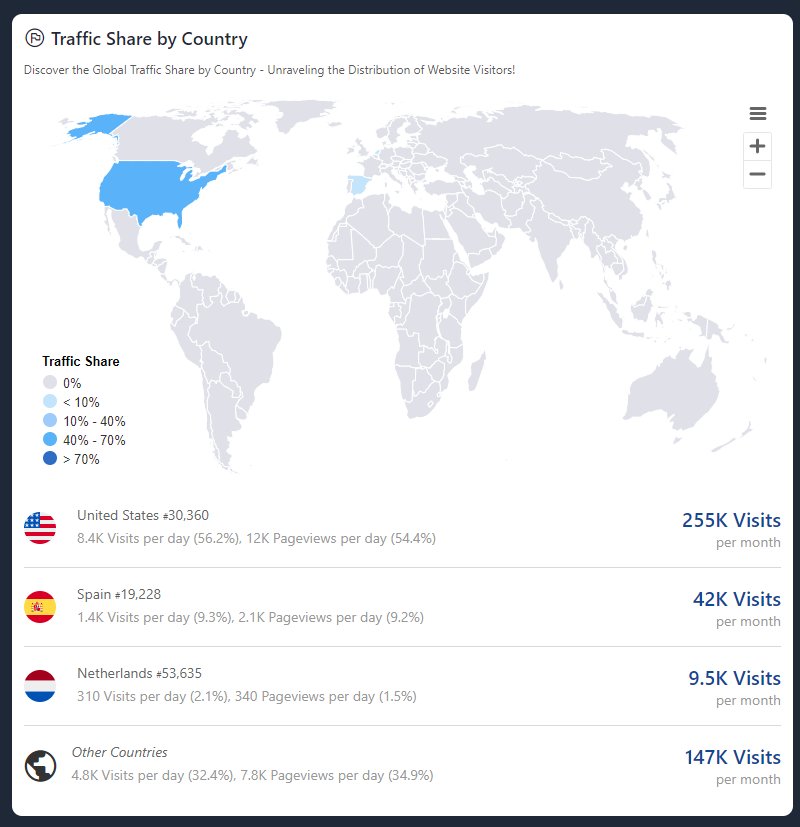
Furthermore, the tagline "Gibiru is the preferred Search Engine for Patriots" garners attention. This doesn't come as a surprise, given that, according to IPAddress, over 70% of its traffic is from the United States.
The Mastermind Behind Gibiru
Steven Ray Marshall stands as the founder of Gibiru, as delineated on his LinkedIn profile: "Established Gibiru in 2008 to offer a privacy-conscious alternative to the surveillance-driven economy. Currently engaged in developing a blockchain search engine and methods for seamlessly transitioning Web 2.0 sites to Web3-compatible formats."
Despite co-founding another venture (www.shieldcoms.com) and serving as Head of Global Analytics for a separate entity, his LinkedIn headline predominantly reads: "Founder of Gibiru - The Uncensored Private Search Engine," suggesting a deep-rooted affinity for the initiative."

Commitment to User Privacy
At the heart of Gibiru's mission is a steadfast commitment to user privacy. It aspires to be a haven for confidential, unfiltered searches, providing a platform for anonymous and uncensored queries.
So, what's the issue with mainstream search engines?
Popular search engines such as Google, Bing, and Yahoo often retain and monetize search queries. These data are not only sold to corporations but also, at times, surrendered to governments without your consent. In the United States, companies like these can be compelled by the National Security Agency (NSA) to disclose extensive user information—including search history, IP addresses, and purchase records—without any judicial oversight.
If this isn't a flagrant breach of privacy, it's hard to envision what could be worse.
Gibiru's Privacy Safeguarding Strategy
First and foremost, it's important to note that as users, we lack the ability to scrutinize Gibiru's code since it isn't Open Source, to our knowledge.
The absence of access to the source code, particularly on the server side, makes it challenging to verify if Gibiru adheres to its privacy policy commitments, such as not retaining search logs or selling user data.
However, they do disclose that they: "may collect your email address if you provide it to us as it pertains to the Gibiru Token program and may occasionally email you with updates regarding Gibiru Token distribution or our crowdsource scraping app."
They further assert that: "server logs may be periodically monitored to manage bandwidth and site performance. These audits do not access or utilize any personally identifiable information like your IP address."
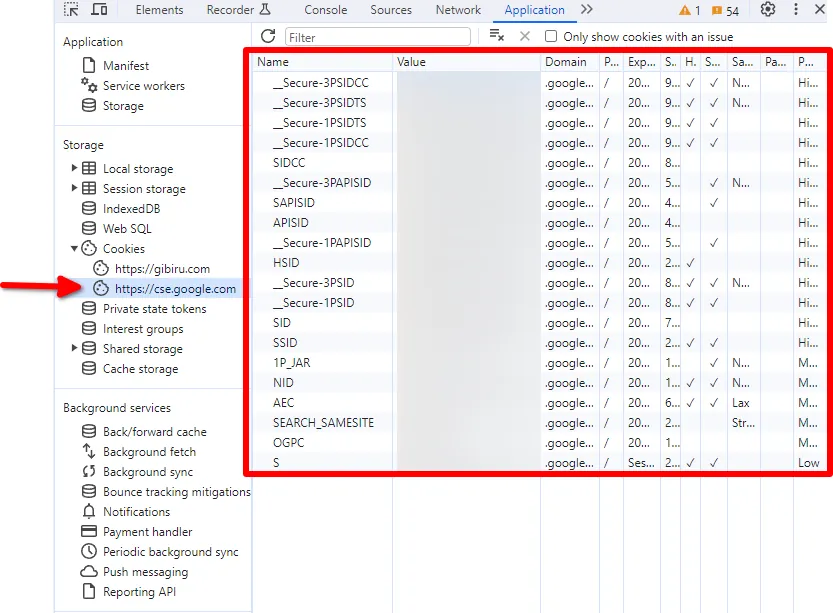
In terms of cookies, Gibiru itself doesn’t create any. Nonetheless, when utilizing Google Custom Search (CSE), a cookie is generated for its functioning, as illustrated in the screenshot below:
Understanding the Cookies Set by Google Custom Search (CSE)
Google’s cookies are multifunctional, handling user authentication, preferences, security, and tracking for both advertising and personalization purposes.
They are integral to the operation and customization of Google's services.
When utilizing Google Custom Search (CSE), several cookies are placed that are typically associated with tracking for advertising and customization purposes:
NID: Houses a unique ID that Google employs to recall your preferences, such as language, search result count per page, and SafeSearch filter status. It's instrumental in displaying ads tailored to your interests.
SID and SSID: These cookies archive data on your website usage and any prior ads you've viewed. They're integral to Google's advertising tracking and personalization framework.
_Secure-3PAPISID, _Secure-1PAPISID, and APISID: Google uses these to compile a user interest profile and serve pertinent ads on their platforms.
1P_JAR: Aids in gathering website metrics, tracking conversion rates, and fine-tuning Google ad personalization.
AEC: Aims to thwart fraudulent web requests and safeguard user data from unauthorized access.
SEARCH_SAMESITE: This cookie supports ad customization based on user search and browsing activities.
OGPC: Deployed by Google to deliver services and extract anonymized browsing insights.
It's crucial to acknowledge that tracking methods and cookie applications evolve over time.
For the most current details, refer to Google's official cookie policy.

Understanding Gibiru's Use of Web Trackers
To assess whether Gibiru employs Web Trackers, we'll reference a report from Netcraft's tool. First, let's clarify the concept of Web Trackers.
What are Web Trackers?
Web Trackers are essentially third-party resources loaded onto a webpage. These can be in the form of social media sharing widgets, javascript files, or images, with the primary objective of monitoring users. The data they gather is chiefly utilized for advertising or analytical intentions.
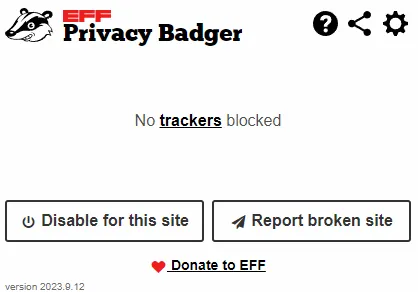
For Gibiru, the Netcraft report indicates the absence of trackers, which supports its privacy commitment.
This finding is corroborated by the EFF's Privacy Badger extension, which also didn't detect any trackers.
The comprehensive report is available here.
The Technical Backbone of Gibiru
As noted earlier, the Gibiru platform is not open source, and our insights may be speculative.
However, based on our observations, it seems that Gibiru might be utilizing WordPress in combination with a custom JavaScript file.
The website executes the following JavaScript code: https://gibiru.com/assets/js/gibiru.js
JavaScript
(function($) { "use strict"; // Start of use strict //URL decode the value in the search box var initialSearchValue = $('#q').val() || ''; $('#q').val(decodeURIComponent(initialSearchValue.replace(/\+/g, ' '))); $('[data-toggle="tooltip"]').tooltip('show'); // Smooth scrolling using jQuery easing $('a.js-scroll-trigger[href*="#"]:not([href="#"])').click(function() { if (location.pathname.replace(/^\//, '') == this.pathname.replace(/^\//, '') && location.hostname == this.hostname) { var target = $(this.hash); target = target.length ? target : $('[name=' + this.hash.slice(1) + ']'); if (target.length) { $('html, body').animate({ scrollTop: (target.offset().top - 56) }, 1000, "easeInOutExpo"); return false; } } }); // Closes responsive menu when a scroll trigger link is clicked $('.js-scroll-trigger').click(function() { $('.navbar-collapse').collapse('hide'); }); // Activate scrollspy to add active class to navbar items on scroll $('body').scrollspy({ target: '#mainNav', offset: 57 }); // Collapse Navbar var navbarCollapse = function() { if ($("#mainNav").offset().top > 250) { $("#mainNav").addClass("navbar-shrink"); } else { $("#mainNav").removeClass("navbar-shrink"); } }; // Collapse now if page is not at top navbarCollapse(); // Collapse the navbar when page is scrolled $(window).scroll(navbarCollapse); // Scroll reveal calls window.sr = ScrollReveal(); sr.reveal('.sr-icon-1', { delay: 200, scale: 0 }); sr.reveal('.sr-icon-2', { delay: 400, scale: 0 }); sr.reveal('.sr-icon-3', { delay: 600, scale: 0 }); sr.reveal('.sr-icon-4', { delay: 800, scale: 0 }); sr.reveal('.sr-button', { delay: 200, distance: '15px', origin: 'bottom', scale: 0.8 }); sr.reveal('.sr-contact-1', { delay: 200, scale: 0 }); sr.reveal('.sr-contact-2', { delay: 400, scale: 0 }); // Magnific popup calls /*$('.popup-gallery').magnificPopup({ delegate: 'a', type: 'image', tLoading: 'Loading image #%curr%...', mainClass: 'mfp-img-mobile', gallery: { enabled: true, navigateByImgClick: true, preload: [0, 1] }, image: { tError: '<a href="%url%">The image #%curr%</a> could not be loaded.' } });*/ function getBrowser() { //bowser.js is required if(window.bowser){ var browser = bowser.getParser(window.navigator.userAgent); var browserName = browser.getBrowserName().toLowerCase().replace(/ /g,'-') || 'other-browser'; var device = browser.getPlatform().type || ''; var vendor = browser.getPlatform().vendor || ''; var version = parseInt(browser.getBrowserVersion(),10) || 0; var extensionCompat = 'is-ext-compat'; //These browser are not compatible with the extension if((browserName === 'chrome' && vendor === 'Apple' && version < 56) || (browserName === 'firefox' && version < 55)){ extensionCompat = 'not-ext-compat'; } return browserName + " is-" + device + " " + extensionCompat; } } $('body') .addClass(getBrowser()) .on('click', '.install-cta-close', function(){ $('.install_ext_cta').fadeOut(250); }) .on('click', '.install-opensearch', function(e){ e.preventDefault(); addOpenSearch('gibiru','g'); }) .on('click', '.install-bookmark', function(e){ e.preventDefault(); bookmark(); }); var isStaticPage = $('#install-edge, #extension-installed, #download-app, #vpn, #proxy-browser').length; if(isStaticPage){ $('.js-scroll-trigger').click(); } })(jQuery); // End of use strict function bookmark(){ var bookmarkURL = window.location.href; var bookmarkTitle = document.title; if ('addToHomescreen' in window && addToHomescreen.isCompatible) { // Mobile browsers addToHomescreen({ autostart: false, startDelay: 0 }).show(true); } else if (window.sidebar && window.sidebar.addPanel) { // Firefox <=22 window.sidebar.addPanel(bookmarkTitle, bookmarkURL, ''); } else if ((window.sidebar && /Firefox/i.test(navigator.userAgent)) || (window.opera && window.print)) { // Firefox 23+ and Opera <=14 $(this).attr({ href: bookmarkURL, title: bookmarkTitle, rel: 'sidebar' }).off(e); return true; } else if (window.external && ('AddFavorite' in window.external)) { // IE Favorites window.external.AddFavorite(bookmarkURL, bookmarkTitle); } else { // Other browsers (mainly WebKit & Blink - Safari, Chrome, Opera 15+) alert('Press ' + (/Mac/i.test(navigator.platform) ? 'Cmd' : 'Ctrl') + '+D to bookmark this page.'); } return false; } function addOpenSearch(name,meth){ if (window.external && ("AddSearchProvider" in window.external)) { console.log(window.external.AddSearchProvider); // typeof weASP matches IE, wc matches Chrome, wnv matches Camino (bugs 430058/430067/430070) if (meth == "p" && ((window.chrome) || (typeof window.external.AddSearchProvider == "unknown") || (window.navigator.vendor == 'Camino'))) { alert("This plugin uses POST which is not supported by all implementations of OpenSearch."); } else { //console.log("https://mycroftproject.com/installos.php/" + pid + "/" + name + ".xml"); window.external.AddSearchProvider( "/assets/" + name + ".xml"); } } else { alert("Your browser does not support OpenSearch search plugins."); } } var classNames = []; if (navigator.userAgent.match(/(iPad|iPhone|iPod)/i)) classNames.push('device-ios'); if (navigator.userAgent.match(/android/i)) classNames.push('device-android'); var html = document.getElementsByTagName('html')[0]; if (classNames.length) classNames.push('on-device'); if (html.classList) html.classList.add.apply(html.classList, classNames); $('.has-clear input[type="text"]').on('input propertychange', function() { var $this = $(this); var visible = Boolean($this.val()); $this.siblings('.form-control-clear').toggleClass('hidden', !visible); }).trigger('propertychange'); $('.form-control-clear').click(function() { $(this).siblings('input[type="text"]').val('') .trigger('propertychange').focus(); }); $(document).ready(function() { // Hide the div $("#badds").hide(); // Show the div in 5s $("#badds").delay(2000).fadeIn(500); });Breaking Down the Code: A GPT-4 Analysis
The code is structured to perform several functions. Here’s a summary of GPT-4's analysis:
Encapsulation in a Self-Executing Function: The code is wrapped within a self-executing function that passes jQuery as an argument. This prevents namespace pollution and allows safe use of the $ sign as a shortcut for jQuery.
URL Decoding: Initially, the script decodes the search box's value to correctly display any URL-encoded special characters.
Tooltip Initialization: Bootstrap's tooltip plugin is utilized to enable automatic tooltip display.
Smooth Scrolling Implementation: Utilizes the jQuery Easing library for smooth scrolling effects for in-page links.
Responsive Menu Closure: Ensures the collapsible menu closes upon clicking a link that triggers a scroll.
ScrollSpy Activation: Employs Bootstrap's ScrollSpy to dynamically update navigation links based on the scroll position.
Navbar Transformation: Modifies a class on the navbar in response to scrolling, potentially altering its appearance.
ScrollReveal Animation: Integrates the ScrollReveal library to animate elements upon entering the viewport.
Browser Identification: Employs the bowser.js library to deduce the user's browser type.
Bookmark and OpenSearch Features: Implements functions to bookmark the current page or set it as a search provider in the user's browser.
Device Compatibility Checks: Identifies if the user is on an iOS or Android device and adjusts the HTML element classes accordingly.
Input Management: Provides mechanisms for clearing text inputs and managing the visibility of specific elements.
Document Ready Actions: Conceals then reveals a div with a delay upon the document's readiness.
JavaScript
function addOpenSearch(name, meth){ if (window.external && ("AddSearchProvider" in window.external)) { // typeof weASP matches IE, wc matches Chrome, wnv matches Camino (bugs 430058/430067/430070) if (meth == "p" && ((window.chrome) || (typeof window.external.AddSearchProvider == "unknown") || (window.navigator.vendor == 'Camino'))) { alert("This plugin uses POST which is not supported by all implementations of OpenSearch."); } else { //console.log("https://mycroftproject.com/installos.php/" + pid + "/" + name + ".xml"); window.external.AddSearchProvider( "/assets/" + name + ".xml"); } } else { alert("Your browser does not support OpenSearch search plugins."); } }Exploring the OpenSearch Integration
The addOpenSearch function presents an intriguing capability. OpenSearch is a protocol that allows browsers to adopt a custom search engine, contingent upon the browser’s support for OpenSearch.
Here’s an in-depth look at the function:
- Compatibility Assessment: The function initially ascertains the browser’s compatibility with OpenSearch using the window.external object alongside the AddSearchProvider function.
- Method Appraisal: When the 'p' parameter is passed to the 'meth' variable, an additional verification is conducted to confirm support for OpenSearch plugins employing the POST method, given that not all browsers facilitate POST method for OpenSearch. In instances of incompatibility, the user is alerted.
- Search Provider Addition: Consequent to confirming browser compatibility and POST method support, the function integrates a new search provider through window.external.AddSearchProvider. It presumes the provider’s XML file resides within the /assets/ directory, with its name conveyed as a function argument. This XML delineates the requisite details for the browser to establish the new search engine.
- Incompatibility Notification: Should the browser lack OpenSearch support, the user is notified via an alert message.
Exploring Gibiru's DNS Setup
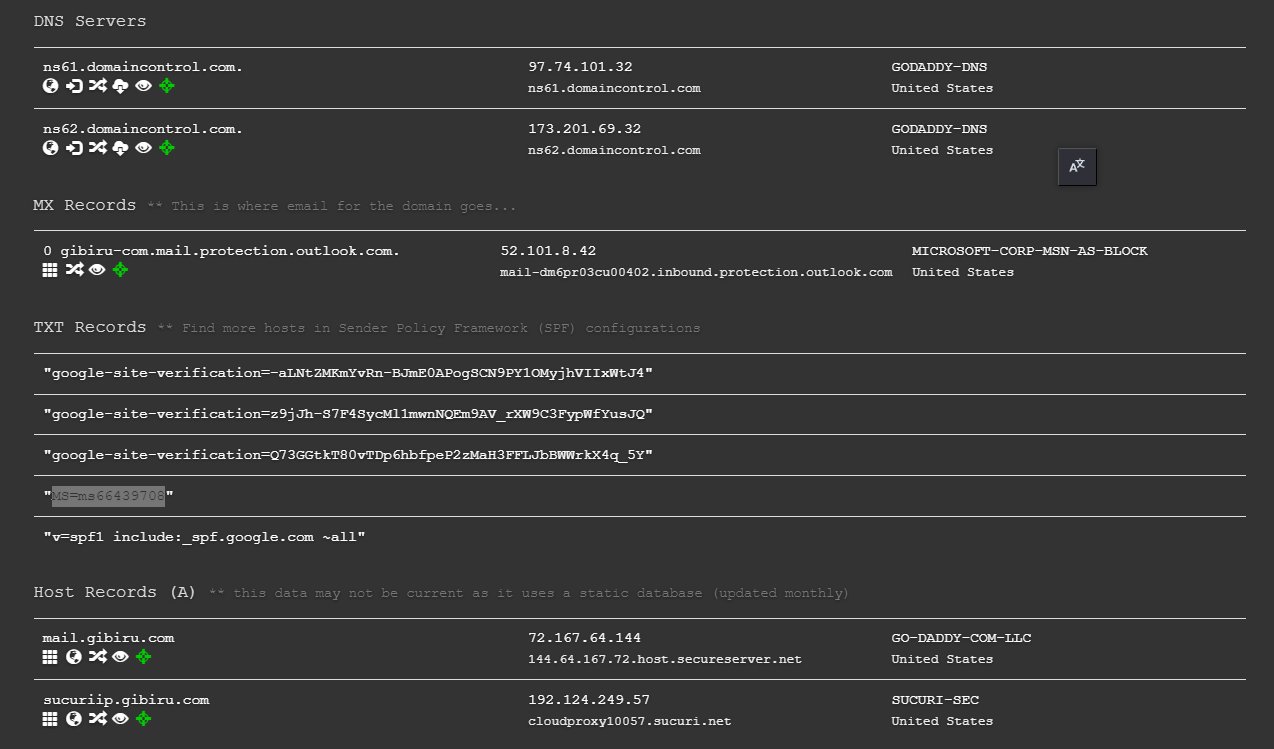
Venturing beyond the usual analysis of a search engine, we explore the DNS configuration that Gibiru employs.
Employing the tool dnsdumpster.com reveals that the site is hosted via GoDaddy and possesses a subdomain named 'sucuriip' This subdomain is associated with Sucuri CloudProxy, which functions as a content delivery network (CDN) and web application firewall (WAF), commonly utilized across various websites
Google's Indexing of Gibiru: A Closer Look
Scrutinizing Gibiru's Presence in Google's Index
Interestingly, a significant portion of this search engine's user traffic originates from Google. Driven by curiosity, we explored the extent of Gibiru's presence within Google's index by employing the search query site:https://gibiru.com/
The search yielded 47 indexed pages. Below is a list of some pages that are not readily accessible from Gibiru's homepage.
- https://gibiru.com/incognito-mode/
- https://gibiru.com/gibiru-support/
- https://gibiru.com/install-edge/
- https://gibiru.com/author/gibiru_admin/
- https://gibiru.com/results.html?q=mondoraro.org&rt=&cx=partner-pub-5956360965567042%3A8627692578&cof=FORID%3A11&ie=UTF-8
- https://gibiru.com/iphone-add-to-home-screen/
Evaluating Gibiru for Everyday Use
When encountering a new meta-search engine or search engine, the fundamental question we invariably pose is: Can it serve as the primary search engine for everyday use?
The answer consistently hinges on individual preferences and requirements.
To conduct a relatively equitable assessment, we've categorized the searches into four distinct types:
- Georeferenced searches
- News searches
- Product-specific searches
- General knowledge searches
We then compared the search results between Google and Gibiru, recognizing Google as the de facto standard for search quality due to its global dominance.
Georeferenced Searches
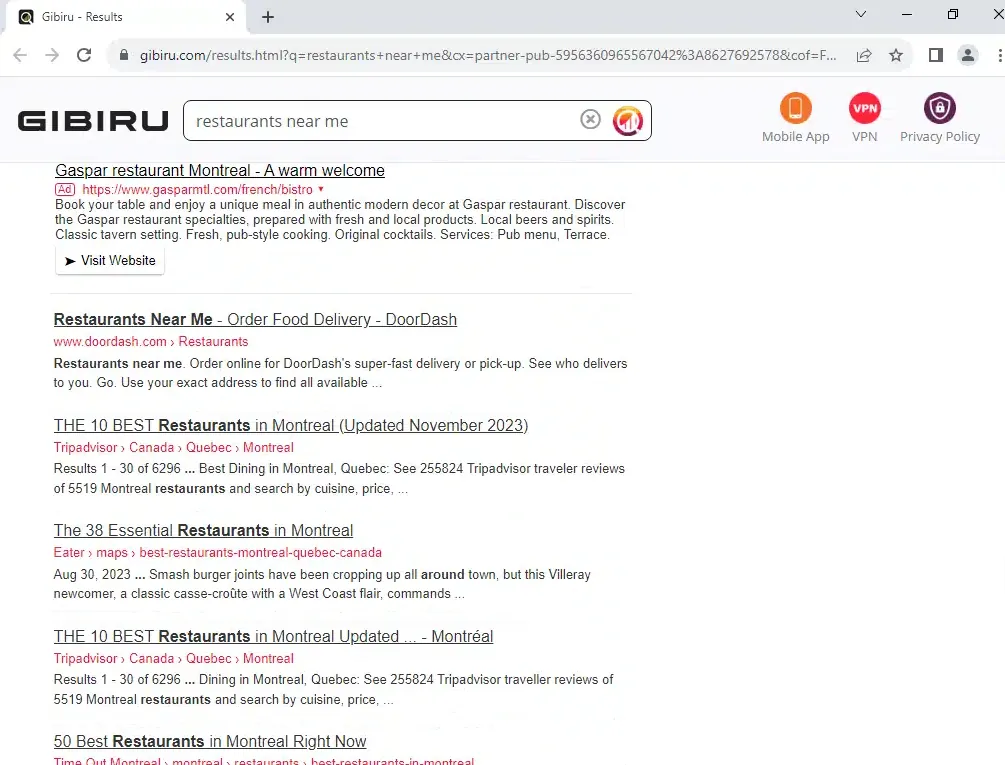
For users reliant on geolocated queries, such as "restaurants near me", alternative search engines might not match the precision of Google or Bing.
Conversely, for generic inquiries, research, or accessing platforms, these search engines can deliver a commendable experience.
Meta-search engines leveraging Google Custom Search (now termed Programmable Search Engine) benefit from Google's technology.
This proves advantageous, especially for georeferenced results. Hence, a search like "restaurants near me" on Gibiru will yield results akin to those on Google.
News Searches
For users for whom news forms a critical component of search engines, timeliness is crucial. Gibiru, through Google's technology, provides news as current as Google's own search results.
Product-Specific Searches
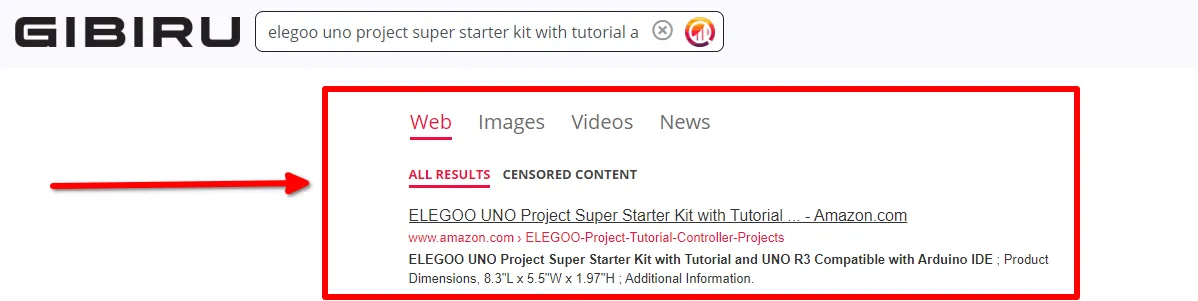
This test involves searching for a particular product, like the ELEGOO UNO Project Super Starter Kit.
The expectation is to at least find the product's Amazon page or the manufacturer's site.
Gibiru meets this expectation by returning the anticipated results.
General Knowledge Searches
This category entails searching for general topics, such as querying the French author Anatole France.
Expected results typically include biographies, Wikipedia pages, and other authoritative sources.
In this instance, Gibiru's results closely mirror those of Google, offering the author's Wikipedia entry, a profile on Nobelprize.org, and an Encyclopedia Britannica article.

Exploring Gibiru's Mobile Applications
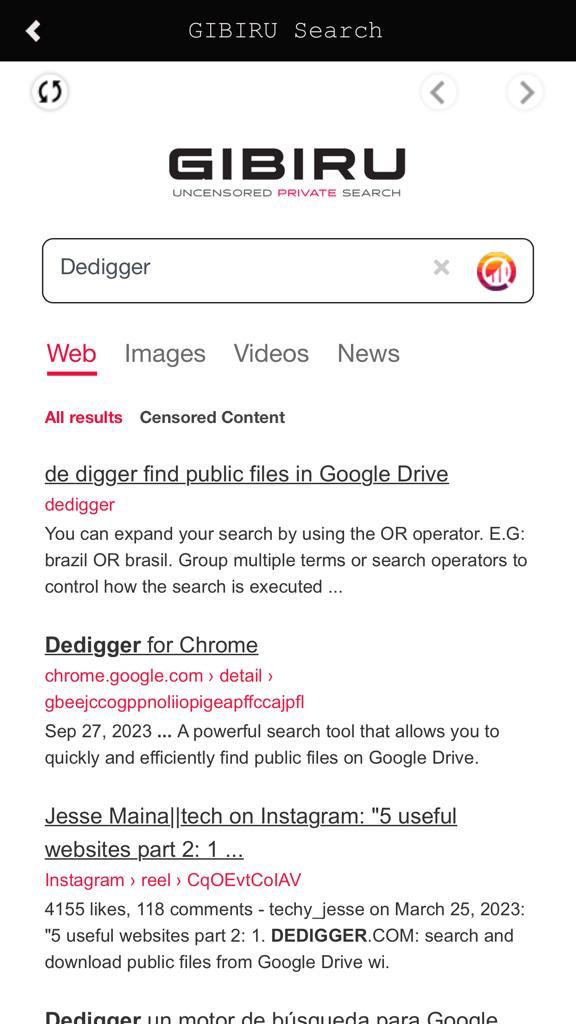
Gibiru markets its applications under the banner of "Proxy Browser Wormhole", positioning them as intermediaries that facilitate remote access to computers, servers, or applications from a device other than one's own.
For iOS users, the application remains accessible for download. However, the Android counterpart has vanished from the Google Play Store, as indicated by the broken link: https://play.google.com/store/apps/details?id=com.app.gibiru
Decoding Gibiru's Financial Sustenance
Gibiru adopts a non-intrusive economic model. According to their official site:
"Earned Integrity. Our financial sustenance is purely commission-based. Whenever our users engage in a purchase or initiate an action through Gibiru, we earn a commission. We staunchly refrain from profiting by trading your personal search logs, political leanings, or interests."
While we can conjecture, our insights remain hypothetical, drawn solely from observations of their platform and not extending beyond that.

Monetizing Search: AdSense for Gibiru
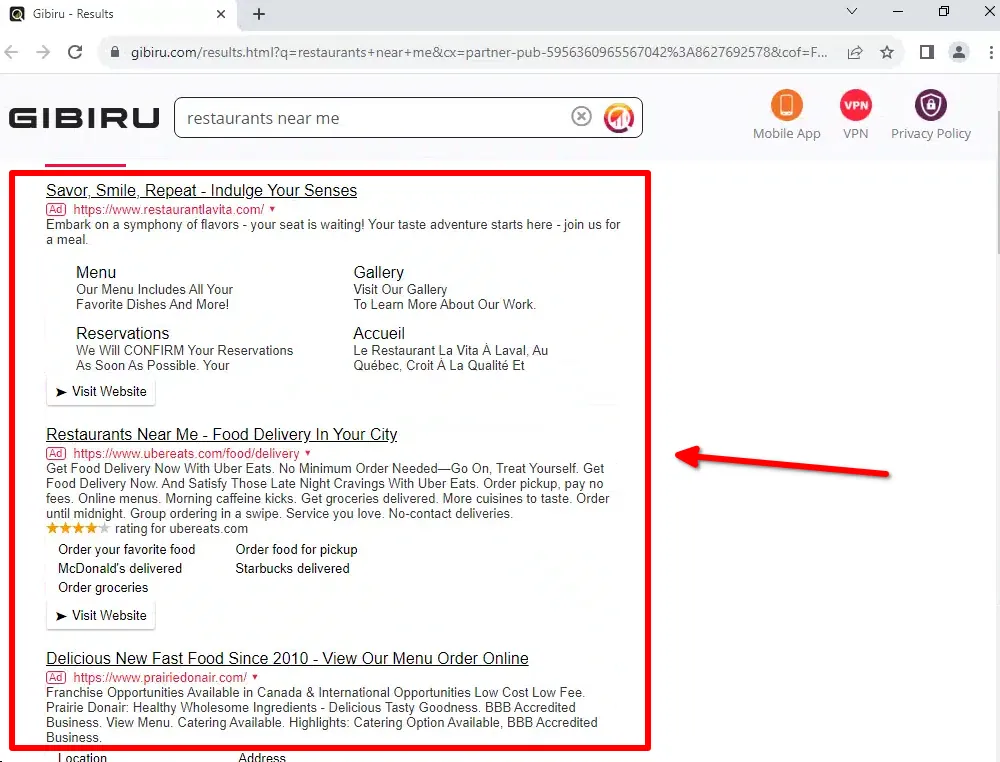
Gibiru may potentially accrue revenue via Google Custom Search, a member of the AdSense for search (AFS) suite, which facilitates monetization.
Industry insights suggest that the average revenue per click (RPC) through Google AdSense on Custom Search can significantly fluctuate, contingent on factors like the advertiser's profile, the nature of the website or search engine, and the geographical location of the user. Estimates indicate an RPC range between $0.05 and $0.50, although these figures are speculative and actual earnings may diverge.
It's crucial to acknowledge that AdSense earnings are dynamic and prone to fluctuations.
As per the latest data available at the time of this analysis, publishers garner 51% of the revenue acknowledged by Google.
Decoding Gibiru's Affiliate Ventures
A plausible revenue stream for Gibiru might be derived from affiliate marketing programs
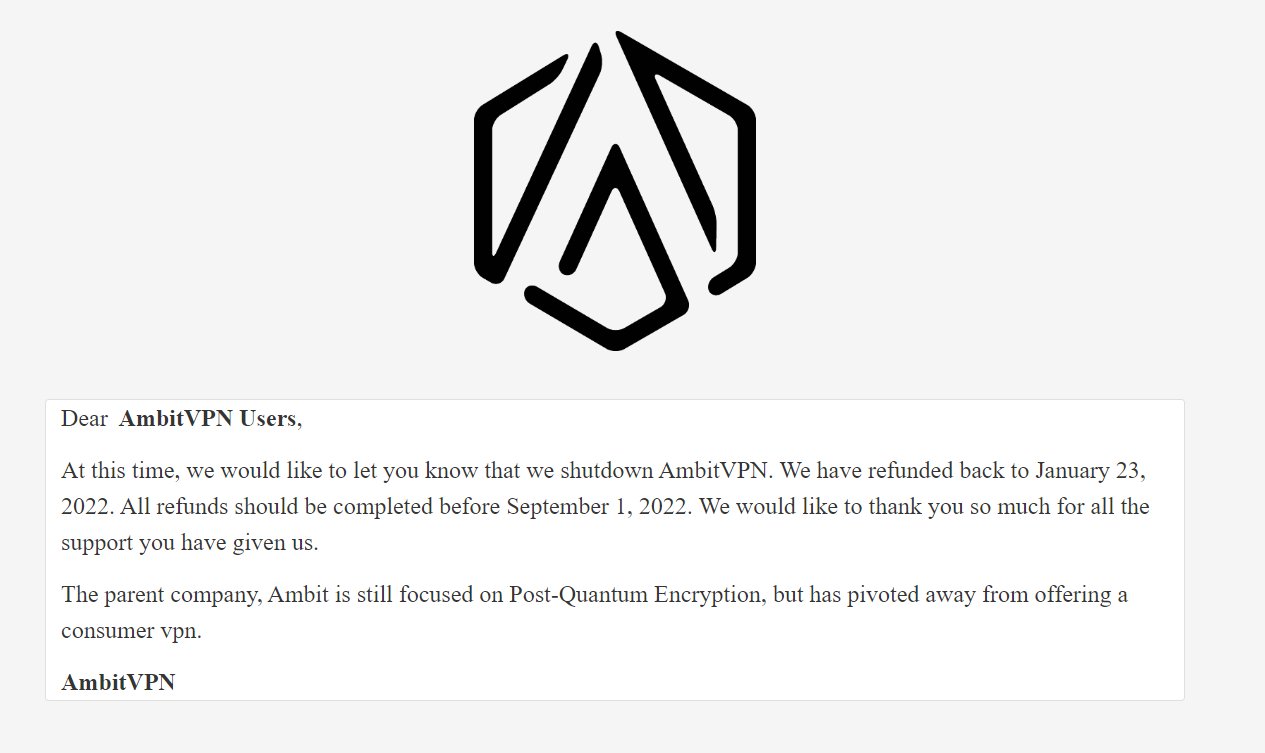
On its homepage, Gibiru hosts a dedicated section espousing the virtues of using a VPN for secure internet browsing, where they once endorsed AmbitVPN through a referral link.
Nonetheless, AmbitVPN has ceased operations since September 1, 2022, nullifying any potential earnings for Gibiru from this affiliation.
Curiously, we stumbled upon another page which directs to Express VPN via this link: https://www.linkev.com/?a_fid=Gibiru.
This screenshot evidences the affiliation:

Scrutinizing Gibiru's Financial Prospects
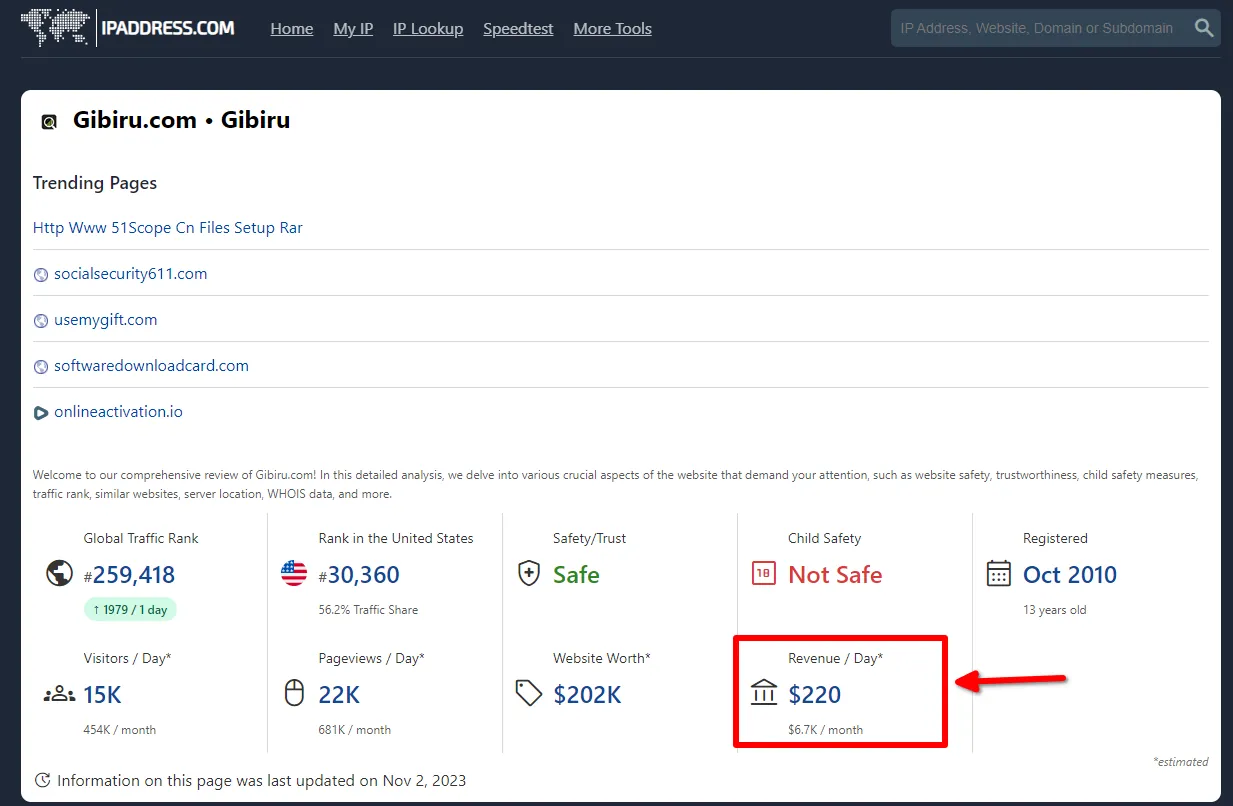
Based on data from the IPAddress platform, Gibiru is purported to attract approximately 15k visitors daily, with an estimated revenue generation of $220 per day, culminating in a speculative monthly income of around $6.7k.
Nevertheless, we approach these figures with a degree of skepticism.
Wrapping Up: A Comprehensive Look at Gibiru
Gibiru delivers acceptable results, on par with those returned by Google. Of course, this is not surprising, given that Gibiru is actually a meta-search engine that uses Google's technology through Google Custom Search for its searches.
While the meta-search site is mostly fully functional, the project seems a bit 'abandoned' or at least not so well-maintained. It's the small signs that lead us to think this, such as the fact that the Android app is no longer available, the link to a VPN that stopped working more than a year ago, and the outdated copyright date in the footer of some of its pages.
On the other hand, although no web tracker was detected and there is no Gibiru cookie, a third-party cookie is used, in this case from CSE (Google).
As it is not an Open Source project, it is not possible to audit the code to verify that indeed no IP or any other data that may compromise user privacy is stored.
In short, Gibiru is an option, at least an interesting one. If you want to try a different search engine, we encourage you to take a look at the project.